Hours of Service (HOS) Rules Explained for Truck Drivers
Truck drivers often spend long hours on the road transporting goods across different locations. While this is essential for the economy, long driving hours can lead to fatigue, reduced concentration, and increased risk of accidents.
To address these risks, Hours of Service (HOS) regulations were introduced to limit driving hours and ensure that drivers take adequate rest breaks. These rules are designed to improve road safety, protect drivers, and reduce fatigue-related accidents.
In this guide, we will explain Hours of Service (HOS) rules for truck drivers, key requirements, and how proper training helps ensure compliance.
What Are Hours of Service (HOS) Rules?
Hours of Service (HOS) rules are regulations that limit the number of hours a commercial driver can operate a vehicle within a specific period.
These rules are designed to:
- Prevent driver fatigue
- Improve road safety
- Ensure proper rest periods
- Maintain compliance with transportation laws
HOS rules apply to most commercial drivers and are strictly enforced.
Key HOS Rules for Truck Drivers
Understanding HOS regulations is essential for every commercial driver.
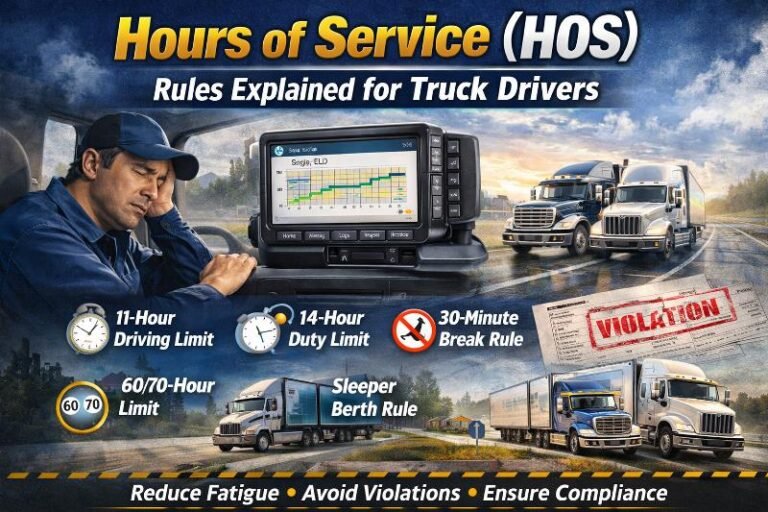
11-Hour Driving Limit
Drivers can drive a maximum of 11 hours after taking 10 consecutive hours off duty.
14-Hour Duty Limit
Drivers cannot drive beyond the 14th consecutive hour after coming on duty, even if they take breaks.
30-Minute Break Rule
Drivers must take a 30-minute break after 8 hours of driving.
60/70-Hour Limit
Drivers cannot drive after 60 hours on duty in 7 days or 70 hours in 8 days.
Sleeper Berth Rule
Drivers using sleeper berths must follow specific rest requirements to ensure proper recovery.
Why HOS Compliance Is Important
Following HOS rules provides several benefits.
Reduces Driver Fatigue
Proper rest helps drivers stay alert and focused.
Improves Road Safety
Fatigue-related accidents are significantly reduced.
Avoids Legal Penalties
Non-compliance can result in fines and violations.
Protects Driver Health
Regular rest improves overall well-being.
Common HOS Violations
Drivers and companies must avoid common mistakes.
Exceeding Driving Limits
Driving beyond allowed hours increases risk and penalties.
Falsifying Logbooks
Incorrect records can lead to serious violations.
Skipping Required Breaks
Breaks are essential for safety and compliance.
Poor Record Keeping
Accurate logs are required for inspections.
Electronic Logging Devices (ELDs)
Electronic Logging Devices (ELDs) are used to track driving hours automatically.
Benefits of ELDs:
- Accurate record keeping
- Easy compliance tracking
- Reduced paperwork
- Improved transparency
ELDs play a key role in ensuring HOS compliance.
HOS Training for Truck Drivers
Proper training helps drivers understand and follow HOS regulations effectively.
Drivers learn:
- How to track driving hours
- Understanding duty status
- Compliance with regulations
- Avoiding violations
Training programs offered by Compliance Courses Online help drivers gain the knowledge needed to stay compliant and safe on the road.
Recommended HOS Training Course
Hours of Service (HOS) Training
This course helps drivers understand HOS regulations and maintain compliance.
The training covers:
- Driving limits and rest requirements
- Logbook and ELD usage
- Compliance best practices
- Avoiding violations
Conclusion
Hours of Service (HOS) rules are essential for maintaining safety in the trucking industry. By limiting driving hours and ensuring proper rest, these regulations help reduce fatigue and prevent accidents.
Understanding and following HOS rules is not just about compliance—it is about protecting lives and ensuring safe operations on the road.
Proper training plays a crucial role in helping drivers stay compliant and perform their responsibilities safely.
Expand Your Compliance Expertise with these Courses
DOT/FMCSA Compliance Training Bundle of 6 Courses for Drivers: $49
Hours-of-Service (HOS) Compliance Training: $25
Truck Driver Fatigue Compliance Course: $25
Drug and Alcohol Awareness Training for Drivers: $25
Pre- and Post-Trip Inspections Compliance Training: $25
Cargo Securement Compliance Training: $25
Defensive Driving for CMV Operators Course: $25